

Table of Contents

Introduction
This case study explores how a parametric pattern generator can be used by architects and designers to translate a continuous image into a controlled, manufacturable panel system. Using Relics Forge | Bricks, a panoramic sunset image was transformed into a buildable wall cladding layout under real-world production constraints.
Rather than treating architecture as a flat graphic surface, this project demonstrates a workflow where image, geometry, and fabrication logic are designed simultaneously. The result is faster decision-making, higher precision, and full confidence that what is designed can actually be built.
Project Overview
Project type: Urban renewal / underground passage refurbishment
Design scope: Architectural wall cladding
Design goal: Create a continuous panoramic image using modular panels
Key constraint: Fixed and variable panel sizes defined by manufacturing limits
The site is an existing underground pedestrian passage—functionally necessary, but visually neglected. The design intervention aimed to transform the passage into an experiential urban moment using a large-scale sunset panorama that unfolds along the tunnel wall.
The Core Design Challenge
Creating a large-scale image in architecture is rarely a purely visual task. In this case, the challenge included:
- Strict panel size limitations dictated by production
- Variable wall lengths and heights along the tunnel
- A limited color range suitable for durable exterior materials
- The need for a clean, production-ready layout
Traditional graphic or parametric tools tend to solve only part of this problem. They either prioritize image quality or geometric freedom—but struggle to integrate fabrication logic early.
This is exactly where a parametric pattern generator designed for architectural reality becomes critical.
Why Use a Parametric Pattern Generator for Architectural Panels?
A parametric pattern generator allows designers to work within real constraints from the first design move. Instead of designing freely and adapting later, constraints such as panel dimensions, color ranges, and site geometry actively shape the outcome.
With Relics Forge | Bricks, the pattern is not decorative-it is structural, measurable, and exportable.
Design Workflow with Relics Forge | Bricks
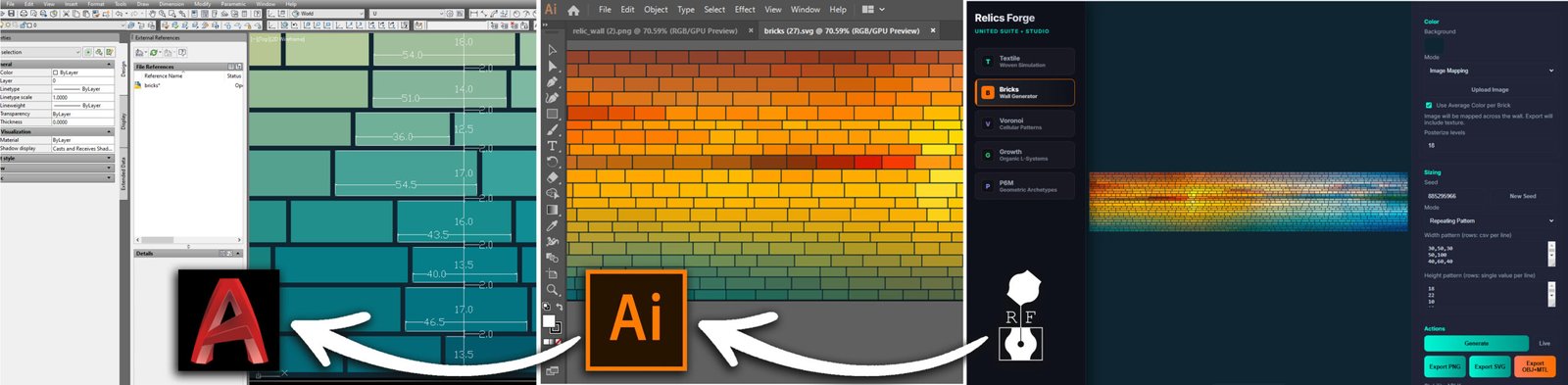
1. Image as Data, Not Decoration
The panoramic sunset was introduced into Bricks as a source image-but treated as a data field rather than a static graphic.
The parametric pattern generator immediately translated the image into:
- A discrete panel grid
- Color information per unit
- A system ready for dimensional control
This shift-from picture to system-is fundamental.
2. Adaptive Panel Distribution
Rather than enforcing a uniform grid, Bricks distributed panels according to:
- Local wall dimensions
- Available panel sizes
- Edge conditions and terminations
Larger panels were placed where continuity allowed, while smaller units resolved geometric constraints without cutting or distortion. The image remained readable, while fabrication efficiency increased.
3. Color Mapping Within Production Limits
The sunset image was remapped into a controlled production palette.
Using the parametric pattern generator, designers could:
- Reduce color resolution intentionally
- Preview gradient behavior per panel
- Ensure consistency across batches and suppliers
This step ensures that visual intent survives the transition from screen to material.


4. Site-Specific Scaling and Alignment
Scaled elevation drawings of the tunnel were imported into Bricks, allowing the panel layout to align precisely with the real site.
The system accounted for:
- Exact wall dimensions
- Openings and joints
- Segment transitions along the passage
The result was not a conceptual visualization, but a construction-ready facade layout.
The Result
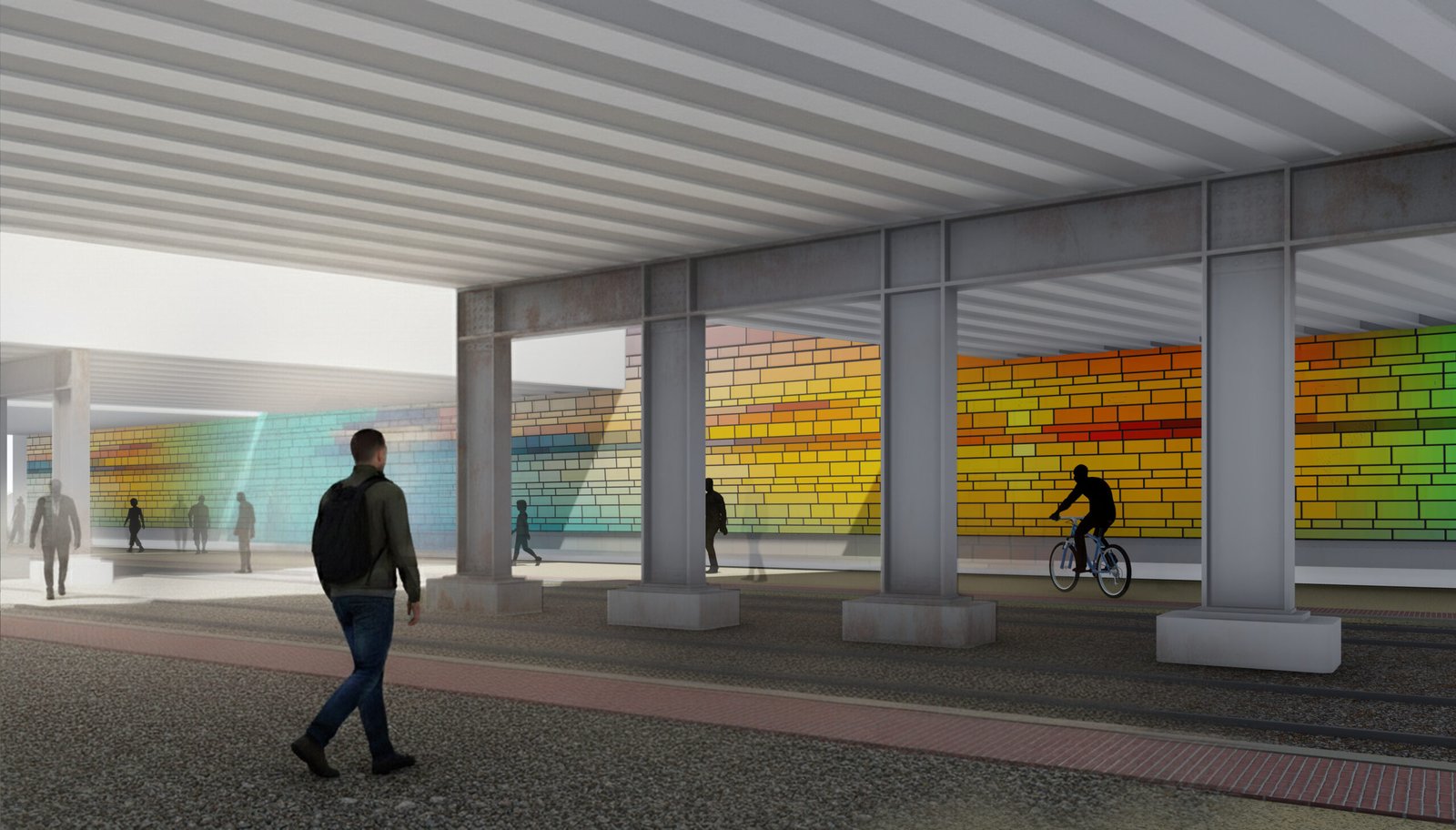
The final installation reads as a continuous panoramic sunset-yet is fully composed of discrete, manufacturable panels.
What was once a forgotten underground passage becomes:
- A memorable urban experience
- A durable architectural surface
- A clear demonstration of controlled, image-based design
Most importantly, the entire workflow-from image import to final layout-was completed in a fraction of the time required by conventional methods.
Why Designers Choose Relics Forge
Relics Forge is built for designers who work under real constraints.
This parametric pattern generator enables:
- Faster design iterations
- Embedded fabrication logic
- Reduced translation errors
- Immediate production-ready outputs
If your work involves facades, cladding systems, public art, or modular architectural surfaces, Relics Forge | Bricks is designed for your workflow—not against it.
Design Faster-Without Losing Control
Stop flattening architecture into images. Stop forcing fabrication to adapt at the last moment.
With Relics Forge, you design once-within real constraints-and move directly toward buildable results.
👉 Join Relics Forge today and experience how a parametric pattern generator should feel.
Design smarter. Design faster. Design for reality.
This case study is the first in a series exploring how a parametric pattern generator can support real architectural workflows-from facades to interiors and beyond.
A similar system-based approach is explored in our acoustic ceiling case study using
Leave a Reply